Vegetable-Tanned Leather: Why It Takes Weeks, and Why It Ages
Around 85 per cent of the leather produced in the world is chrome tanned. It is fast, it is cheap, and the result is soft, even and stable. A small fraction is still tanned with vegetable tannins, in a process that takes weeks rather than hours.
The difference between the two explains almost everything that separates a bag that simply wears out from one that ages.
What tanning is
A raw hide rots. Tanning is the process that turns a hide into leather, stabilising the collagen fibres so that they resist decay. There are two families of method.
Chrome tanning
Uses chromium salts. It takes between a few hours and a day. It produces soft leather with even colour, very stable against water and heat. It accounts for the great majority of world production, and it is what you will find in most shoes, jackets and upholstery.
Vegetable tanning
Uses tannins extracted from bark and wood, traditionally oak, chestnut, mimosa and quebracho. The hide spends weeks in pits or drums of increasing concentration, commonly thirty to sixty days. The result is a firmer, denser leather, with less uniform colour, that responds to light and to use.
The five differences you notice
Ageing. The central difference. Vegetable-tanned leather develops a patina: it darkens, takes on a sheen where it is handled, and with use the piece comes to look like no other. Chrome-tanned leather does not develop a patina. It stays the same, and then it wears.
Structure. Vegetable tanning leaves the leather firmer. A bag keeps its shape when empty. Chrome tanned, it tends to collapse on itself.
Repairability. Vegetable-tanned leather accepts repair, recolouring and reconditioning. Chrome-tanned leather with a pigmented finish does not. This is what decides whether an object can be cared for and kept in use, or simply comes with a guarantee.
Smell. Vegetable-tanned leather smells of wood and tannin. It is the smell people associate with good leather, and this is where it comes from.
Uniformity. Here vegetable tanning loses, and it has to be said. It shows the natural marks of the animal, and the colour varies from lot to lot. Anyone who wants industrial perfection does not want vegetable-tanned leather.
Why it costs more
Three reasons add up.
Time. Weeks in the pit against hours. The capital sits idle, and the tannery has to finance it.
Selection of the hide. Vegetable tanning hides no flaws. It demands better hides from the start, because everything that is there will stay visible.
Scale. Few vegetable tanneries remain in Europe. Without industrial scale, there is no industrial price.
What it asks of its owner
A piece in vegetable-tanned leather is not indifferent to how it is treated, and it is fair to know that before buying.
- It marks with water in the first months. Before the patina forms, a drop leaves a mark. With time and use, that stops happening.
- It darkens with light. A pale piece turns honey-coloured with time. That is the expected behaviour, not a flaw.
- It needs conditioning. A neutral cream once or twice a year stops the fibre drying out and cracking.
- It does not like direct heat. Radiators and a car boot in the sun harden the leather irreversibly.
The questions to ask the seller
Vegetable tanning has no protected legal definition. Two questions separate those who know from those who repeat:
Where does the hide come from, and how was it tanned? A brand that works seriously with vegetable-tanned leather can answer both. Ours are French hides, pasture-raised, vegetable tanned, and it is written on every product page.
Is it full grain or split? Full-grain leather, with its original surface intact, is what develops a patina. A lower layer, sanded and coated, develops nothing, even if it was tanned with tannins.
In our leather goods
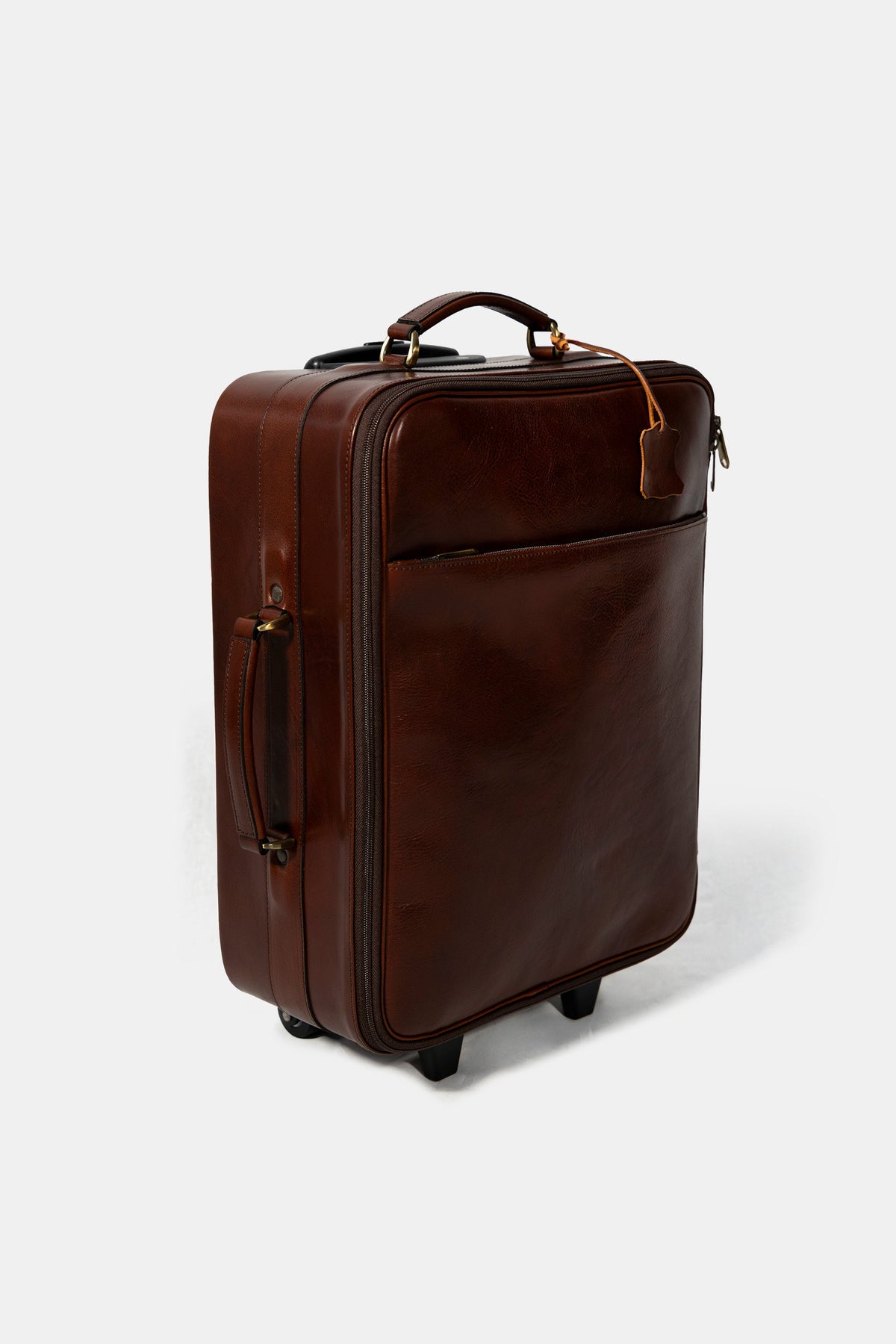
The D'HERITAGE travel trolley, business trolley and wash bag are made in vegetable-tanned leather from French hides, cut and assembled by our specialist leather makers in Portugal, piece by piece, once the order is placed. That means five working days of making before dispatch.
There is no stock because there is no advance production. It is slower, and it is the only way to do this properly.